
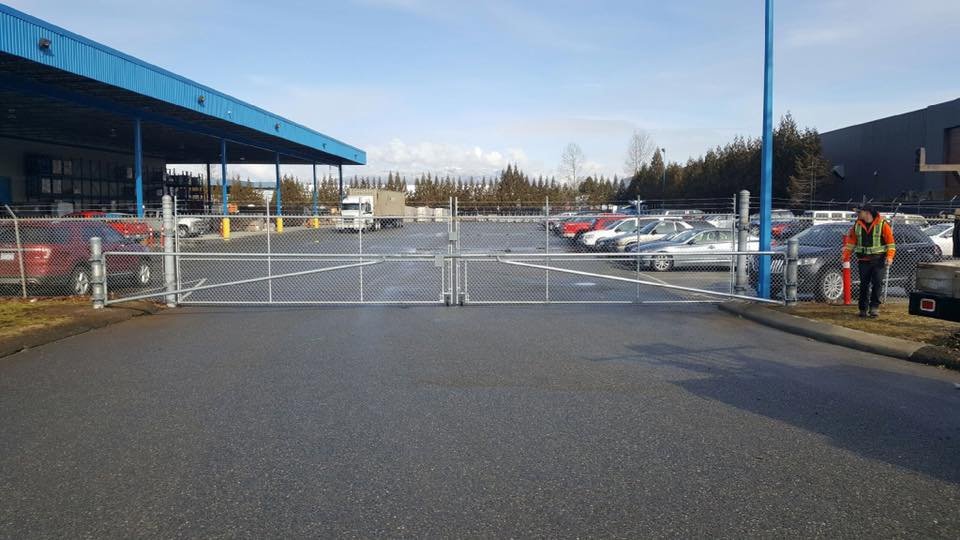
Commercial double swing gate from the LS Fencing project gallery.
Swing, Sliding or Cantilever Gate: Which Fits Your Property?
Compare gate movement, side clearance, slopes, drainage and vehicle access before planning a driveway or commercial entrance.
The best gate is the one that fits the entrance and how people use it. Swing gates need space to pivot; tracked sliding gates travel alongside the fence on a ground track; cantilever gates slide without a track across the driveway. None is the automatic winner for every property. Start with the available space and the vehicles that need access.
When a swing gate makes sense
A single or double swing gate can suit an entrance with enough clear space for the leaves to open. Map the entire opening arc, including parked vehicles, landscaping and pedestrian routes. A driveway that rises behind the entrance can interfere with the bottom of an inward-opening gate. The installer should assess the grade and clearances before fabrication.
For a manual gate, think about where the person opening it will stand and how the leaves will be secured when open. A double gate also needs an agreed meeting point and suitable hardware. Ask how deliveries will enter without leaving a leaf in an exposed or obstructive position.
When a tracked sliding gate makes sense
A sliding gate can be useful when there is limited room to swing into a yard but clear space along the fence. Its track crosses the entrance, so drainage, debris and surface condition matter. Review who will keep the track clear and what happens when dirt, gravel or winter debris collects at the opening.
When a cantilever gate makes sense
A cantilever gate carries its moving section on supports outside the vehicle opening, avoiding a ground track across the driveway. That can suit some commercial entrances, but it needs adequate space beside the opening for the complete gate assembly. The required length, support posts and foundations depend on the design. Do not assume the opening width alone tells you how much room is needed.
Measure the whole access route
- Clear entrance width, including mirrors, trailers and delivery vehicles.
- Space along the fence and inside the property.
- Driveway slope, drainage and the finished surface.
- Turning room and space for a vehicle waiting to enter.
- Separate pedestrian access and visibility on each side.
- Snow storage, landscaping and anything that could obstruct movement.
Add automation after the layout works
An operator does not fix a poorly positioned gate. Give the installer the expected traffic pattern and who needs credentials: residents, staff, deliveries or visitors. Ask for a site-specific safety assessment, suitable protective devices, power requirements and an explanation of operation during a power failure. Gate movements and pinch points require proper design; this guide is not an installation or wiring procedure.
What to send for a gate enquiry
Photograph the entrance from both directions and include the space beside it. Give an approximate opening width, list the largest vehicles and describe the current access problem. LS Fencing can discuss the gate and metalwork scope, then confirm which specialist or operator work is required for the proposed system. Ask for that responsibility to be explicit in the quote.
Frequently asked questions
- Is a cantilever gate always better than a swing gate?
- No. A cantilever gate needs side space and a suitable support design. A swing gate may suit an entrance with a clear opening arc. Site layout decides which is practical.
- Can a manual gate be automated later?
- Sometimes, but the frame, supports, movement, power and protective-device requirements must be assessed. Planning for an operator early can avoid unsuitable hardware or layout.
Related services & guides
Plan your fence or gate project
Tell LS Fencing your location, the type of work and your preferred timing.
Request a quoteBrowse all guidesPlan fence replacement around resident access, vehicle gates, waste collection, temporary boundaries and a clear contractor scope.
Use this visual checklist to describe storm damage, leaning posts, torn mesh and dragging gates before requesting a repair assessment.
Everything a strata council needs to know — barrier arms, parkade rolling doors, cantilever gates, chain link and security fencing, access control, Canadian regulations, and 2026 costs.