
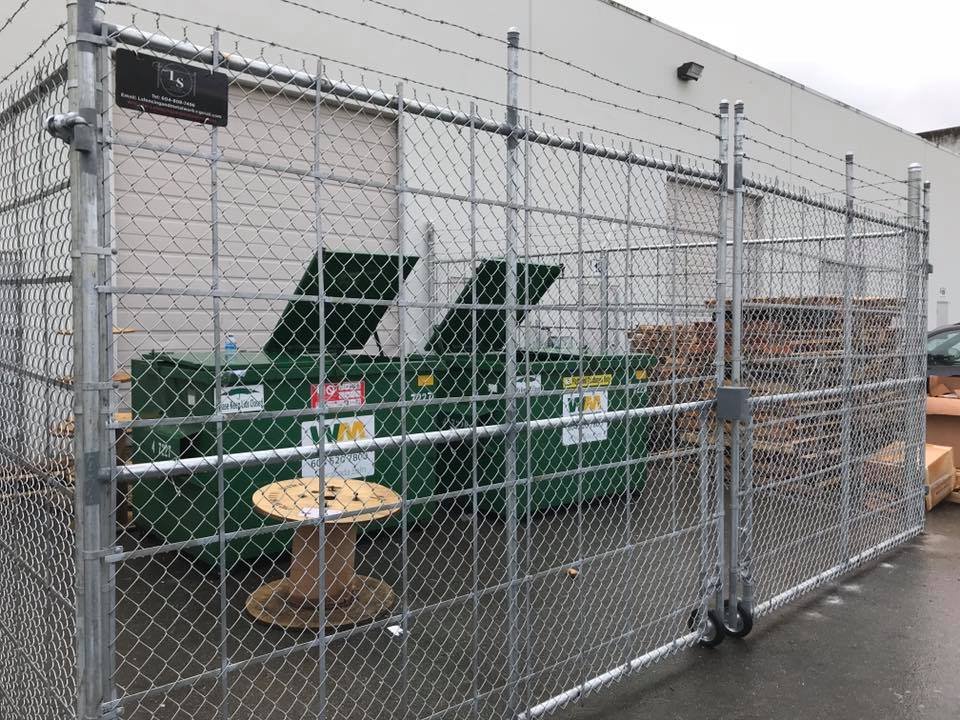
Commercial galvanized chain-link compound with barbed wire topping and cantilever sliding gate securing a strata waste and compactor area in Abbotsford, BC.
The Complete Guide to Strata Parking Gate & Security Fencing Systems in Canada
Everything a strata council needs to know — barrier arms, parkade rolling doors, cantilever gates, chain link and security fencing, access control, Canadian regulations, and 2026 costs.
Unauthorized parking, vehicle theft, catalytic converter theft, tailgating, and unauthorized access to storage areas are persistent — and growing — problems across Canadian strata communities. Whether you manage a 12-unit townhouse complex in Langley or a 400-unit highrise parkade in downtown Vancouver, the challenges are remarkably similar: residents who forget to close gates, visitors who don't belong, and spaces that are genuinely difficult to secure with off-the-shelf solutions.
A properly designed strata parking gate and fencing system solves these problems at the source. It deters opportunistic theft before it happens, creates a clear record of access for liability purposes, reduces resident complaints about stolen property, and — critically — can lower your strata's insurance premiums when properly documented.
But not all gate and fencing systems are created equal. The difference between a $4,000 barrier arm that fails within 18 months and a $9,000 system that runs reliably for 15 years often comes down to specification quality, installation expertise, and matching the right product to the specific demands of your site.
1. Why strata buildings need proper parking gate systems
"Strata councils that choose the cheapest available option typically spend 2–3x the original cost in repairs, replacements, and insurance claims within five years."
Strata parking presents unique challenges that residential or commercial lots don't face to the same degree. You have owners who feel entitled to the space, renters who may not follow protocols, delivery drivers who need occasional access, emergency vehicles that must never be blocked, and a council typically made up of volunteers without specialist knowledge.
Add the physical reality of most strata parkades — limited sightlines, awkward entry geometry, concrete pillars, low ceiling heights, and a decades-old building design never conceived with modern gate systems in mind — and "just install a gate" is never as simple as it sounds.
2. Types of strata parking gate systems
- Barrier arm gate — $3,000–$8,000 installed, 3–6 second cycle, 10–20 year life, low power draw. Best for surface lots and parkade entrances with moderate traffic.
- Overhead rolling door — $5,000–$15,000 installed, 8–15 second cycle, 15–25 year life. Best for underground parkades needing weather protection.
- Sliding (cantilever) gate — $4,000–$12,000 installed, 5–10 second cycle, 12–20 year life. Best for wide surface entrances with high traffic.
Barrier arm gates: the workhorse
For most Canadian strata properties the barrier arm remains the default. Commercial-grade arms from FAAC, BFT and Came are engineered for high-cycle duty in Canadian conditions, with heated control boards for cold-weather reliability, obstruction detection, and battery backup. The key distinction: residential-grade arms are rated for 10–30 cycles per day; commercial-grade for 100–500+. Strata buildings nearly always need commercial-grade, even when the entry looks like a residential driveway.
Overhead rolling doors: maximum weather and security protection
Underground parkade entrances face freeze-thaw cycling, road salt splash, wind-driven rain and snow, and constant thermal cycling. A rolling steel or sectional door handles all of it while providing a near-impenetrable barrier. Specify high-cycle commercial doors rated for 100,000+ cycles, insulated panels, a full-perimeter weather seal, and a motor rated for the actual door weight and height.
Sliding gates for surface lots
On wide surface entrances — common in townhouse complexes and older apartment communities — cantilever sliding gates avoid a ground track that snow, ice or debris can jam. They need more lateral clearance but eliminate the most common maintenance failure point in tracked systems.
3. Security fencing types and applications
Gates are only as effective as the fencing they connect to. A $10,000 barrier arm is meaningless if someone can walk around it through an unsecured perimeter.
- Galvanized chain link — $25–$55/lineal ft installed. Dumpster enclosures, utility areas, perimeter. Proven durability, low maintenance in Canadian climate.
- Chain link with barbed wire — $35–$70/ft. Restricted zones and service yards; a 3-strand top adds meaningful deterrence. Check municipal bylaws.
- Welded wire panel — $40–$80/ft. Bike storage and amenity areas; cleaner appearance, slightly easier to climb.
- Steel palisade / spike top — $65–$130/ft. High-value parking and EV charging zones; excellent anti-climb.
- Concrete bollards — $200–$500 per unit. Vehicle-rated protection for pedestrian zones and storefronts.
- Aluminum ornamental — $55–$110/ft. Street-facing perimeter where curb appeal matters; lower security than steel.
"Chain link is sold in gauges from 9 (heaviest) to 14 (lightest). Specify 9-gauge or 11-gauge galvanized for all strata security applications — anything lighter is a false economy."
Barbed wire and security topping options
The photo above shows a classic three-strand barbed wire top on chain link — exactly the setup appropriate for utility compounds, dumpster enclosures, and restricted service areas. Most municipalities allow it in commercial and industrial zones and on non-street-facing strata fences, but verify local bylaws first. Cleaner-looking alternatives include razor ribbon, anti-climb paint on posts, and anti-climb roller systems that spin when grabbed.
4. Underground parkade fencing: challenges and solutions
- Standard posts cannot be driven into concrete — anchoring must be surface-mounted or core-drilled and chemically anchored.
- Height restrictions (often 2.0–2.4 m clearance) limit fence height and topping options.
- Fire suppression systems and emergency egress requirements limit where fencing can go.
- Drainage slope must be maintained across the fencing footprint.
- Concrete spalling and moisture intrusion affect anchor longevity — stainless fixings are mandatory.
- Noise from gates and motors travels through the concrete structure to units above.
Anchoring systems for concrete parkade floors
Experienced contractors use one of three methods: surface-mounted base plates with chemical anchors, core-drilled post sockets, or proprietary track systems that spread load across a wider slab footprint. Always request engineering sign-off on the anchoring design — dynamic loads from thousands of gate cycles are not what a static wind-load calculation covers.
Noise attenuation
One of the most overlooked specification items and the most frequent source of post-install complaints. Operators bolted directly to concrete transmit vibration to units above and beside the entry. Always include vibration-isolating mounts, and notify residents above the entrance before installation.
5. Hard-to-reach and under-building zones
Every strata property has zones that are genuinely difficult to secure: the gap beneath a raised building, the narrow passage between a parkade wall and a property line, the corner where the loading bay meets the utility compound. Predictably, those are the areas that attract the most problems.
Under-building crawl space and plinth fencing
Many BC and Ontario buildings from the 1970s–1990s have raised ground floors with open space beneath. Closing them requires galvanized welded mesh panels cut to irregular geometry, surface-anchored into the slab, with access panels at maintenance points. Specify minimum 50x50 mm opening, 4 mm wire welded mesh, hot-dip galvanized. Mesh beats bars or chain link here: it holds its shape under deflection loads and can be pre-fabricated off-site to shorten resident disruption.
Narrow passage fencing between buildings
The 600 mm to 1.5 m gap between a building and a property line is a common unauthorized access route and informal dumping ground. Expanded steel mesh in a powder-coated galvanized finish is usually right: cut-resistant, light enough for two-person manual installation in confined space, and wall-anchored on both sides with no ground penetration.
Loading bay and waste enclosure security
Size the gate opening for the largest service vehicle that will enter — typically a roll-off or rear-load truck needing a minimum 4.5 m opening. Gate swing or slide direction must not conflict with the service vehicle approach path, and the ground inside the enclosure should be sealed concrete or asphalt, not gravel, so it can be cleaned and drained.
6. Access control options
- RFID key fobs — $5–$15 per fob. Most popular for strata: easy to program and deactivate, supports owner/tenant/visitor/contractor access levels.
- Smartphone apps — $30–$80/month cloud platform. Virtual guest passes, remote management, no fob replacement cost.
- Licence plate recognition — $8,000–$18,000 installed. Hands-free for whitelisted plates, no fobs to manage.
- Keypad / PIN — $300–$800 per keypad. Low cost, but shared codes are a security risk; use as backup only.
- Intercom / video — $2,500–$12,000 installed. Essential for visitor management; IP systems ring resident smartphones.
- Biometric — $12,000–$30,000 installed. Nothing to lose or share, but PIPEDA privacy obligations must be addressed first.
The tailgating problem
No access control prevents tailgating on its own. The fix is a combination: loop detectors that hold the gate open only while a vehicle is on the loop and close promptly when it clears, gate placement that makes close following geometrically awkward, camera coverage with clear signage, and resident education. Anti-tailgating portals exist but are rarely cost-effective for strata.
7. Canadian regulations and strata law
- British Columbia — Strata Property Act: 3/4 vote required for alterations to common property; fire egress clearance mandatory per BCBC.
- Ontario — Condominium Act, 1998: board approval for common element alterations; accessibility requirements under the AODA.
- Alberta — Condominium Property Act: board resolution required; corporation insurance must cover new installations.
- Quebec — Civil Code of Québec: co-owners' assembly approval; heritage zone restrictions may apply.
- All provinces — National Building Code plus local bylaws: fire department access must not be obstructed, and a building permit is typically required for permanent fencing over 1.2 m.
Unpermitted work can complicate unit sales and may void strata property insurance. Confirm requirements with your local authority having jurisdiction before work begins — don't rely on contractor assurances.
Fire department access
Non-negotiable and frequently misunderstood. Gates serving areas with hydrants, sprinkler connections, or fire department connections must remain unlocked, be fitted with a Knox Box, or use a fire-department-compatible access system. Verify with your local fire marshal before finalizing any gate specification.
8. Full cost breakdown for 2026
- Barrier arm operator (commercial grade): $1,800–$3,500
- Gate arm and hardware: $400–$900
- Access control panel: $600–$2,000
- RFID reader(s): $300–$900
- Traffic loop detectors (entry + exit): $400–$800
- Electrical rough-in and connection: $800–$2,500
- Concrete work and mounting: $500–$2,000
- Intercom / video station: $1,200–$4,000
- Initial fob programming: $5–$15 per unit
- Building permit: $150–$500
- Commissioning and testing: $200–$600
- Total for a 50-unit building: $6,500–$18,200
Budget $800–$2,500 per gate per year for maintenance: two preventive visits minimum on high-traffic installs, operator lubrication and adjustment, loop detector calibration, and a parts reserve for safety edges, limit switches and loop wire. Expect to replace or reprogram 10–20% of your fob pool annually through loss, sales and tenant turnover.
9. Strata council decision checklist
- Get quotes from at least three contractors with strata-specific references, not just commercial or industrial ones.
- Verify insurance and WCB/WSIB coverage — minimum $2M commercial general liability and current workers' compensation registration.
- Confirm building permit requirements directly with your municipality.
- Obtain fire department access confirmation before installation, not after.
- Pass the required strata vote — in BC, a 3/4 vote for common property alterations unless bylaws state otherwise.
- Negotiate the maintenance contract at the same time as the installation contract, while you still have leverage.
- Budget for resident fob programming plus a replacement reserve, and communicate the access transition in advance.
- Review warranty terms: minimum two years parts and labour on the operator, one year on access control electronics.
- Notify your strata insurance carrier and get written confirmation of coverage.
- Document everything — as-built drawings, programming codes stored securely, manuals, and service contacts.
10. Maintenance, longevity and Canadian climate
A system that performs flawlessly through a mild coastal BC winter can fail in its first season in a Winnipeg parkade at −40°C. Climate-appropriate specification is the difference between 20 years of service and replacement in five.
Cold weather specifications
For climate zones 5 through 8, specify operators rated to −40°C, heated control boards, battery backup with cold-rated sealed lead-acid or LFP cells, and stainless hardware throughout. Standard zinc die-cast hardware becomes brittle below −20°C and fails under everyday impact loads.
Coastal corrosion management
In coastal BC and Atlantic Canada, specify hot-dip galvanized steel (not electro-galvanized), powder-coated aluminum operator housings, and 316-series stainless for exposed fasteners. Chain link fabric should be 9-gauge galvanized-before-weaving with a PVC coating for marine environments.
Preventive maintenance schedule
- Monthly: visual inspection, safety edge test, loop detector function test, arm pivot lubrication if specified.
- Semi-annually: full service visit — motor current draw, limit switch calibration, battery load test, hardware torque, access control audit.
- Annually: fencing inspection for post movement, panel deformation, rust and anchor integrity; review emergency access procedures.
- Every five years: full system audit — remaining service life, technology currency, access platform support status.
Replace or repair?
General rule: if repair costs in any 12-month period exceed 30% of operator replacement cost and the system is over 10 years old, replace it. Older systems also create headaches as fob platforms lose support and spare parts dry up. A properly specified and maintained strata gate system should deliver 15–25 years of service and typically pays back in 4–7 years in urban Canadian markets.
Get a quote
L.S. Fencing & Metal Work is a family-owned contractor based at 3095 McCallum Rd Unit #6, Abbotsford, BC, serving strata corporations, property managers and commercial clients across the Fraser Valley and Lower Mainland. We install chain link, ornamental, cedar, barrier gates, hand rails and custom driveway gates, and offer on-site welding. Call or text 604-758-0014 for a free on-site assessment.
Cost figures reflect typical Canadian market conditions as of mid-2026 and are for planning purposes only. This guide is not engineering or legal advice — strata legislation varies by province, so consult a strata lawyer or property manager for jurisdiction-specific guidance.
Frequently asked questions
- How much does a strata parking gate system cost in Canada?
- A single-entry strata parkade gate system typically runs $6,500 to $18,200 installed in 2026. The barrier arm operator itself is only $1,800–$3,500 of that; electrical rough-in, concrete work, access control, intercom, loop detectors, permits and commissioning make up the rest.
- Do strata councils in BC need a vote to install a parking gate?
- Yes. Under the BC Strata Property Act, alterations to common property generally require a 3/4 vote of the ownership unless your bylaws state otherwise. Allow adequate notice time and confirm quorum requirements before scheduling the vote.
- Is barbed wire allowed on strata fencing?
- In most Canadian municipalities barbed wire topping is permitted in commercial and industrial zones and on non-street-facing strata fences such as waste enclosures and utility compounds, usually with a minimum height to the lowest strand. Always verify the local bylaw before specifying it.
- What gauge chain link should a strata property use?
- Specify 9-gauge or 11-gauge hot-dip galvanized chain link for all strata security applications. Lighter 12.5 to 14-gauge fabric sags, stretches and fails within a few years, making it more expensive over the life of the fence.
- How do you fence an underground parkade where posts can't be driven?
- Underground installations use surface-mounted base plates with chemical anchors, core-drilled post sockets, or load-spreading track systems. Stainless fixings are mandatory because of moisture and concrete spalling, and the anchoring design should carry engineering sign-off for the dynamic loads of repeated gate cycles.
- What is the best way to stop tailgating at a strata gate?
- No single technology stops tailgating. Combine loop detectors that close the gate promptly once a vehicle clears, gate placement that makes close following awkward, camera coverage with clear signage, and resident education.
Related services & guides
Sources & further reading
Bylaws are updated by municipalities from time to time — always confirm current requirements before starting work.
Plan your fence or gate project
Tell LS Fencing your location, the type of work and your preferred timing.
Request a quoteBrowse all guidesHeavy-gauge industrial perimeter security fencing for Langley BC — 6-gauge chain link, 358 anti-climb mesh, barbed and razor wire toppings, bylaw limits, footings and access control specs.
Compare gate movement, side clearance, slopes, drainage and vehicle access before planning a driveway or commercial entrance.
CSA Z614 playground fencing, basketball and tennis court perimeters, and dog park airlock gates in Langley, Surrey, Abbotsford and the Fraser Valley — specs, costs, permits and FAQs.