
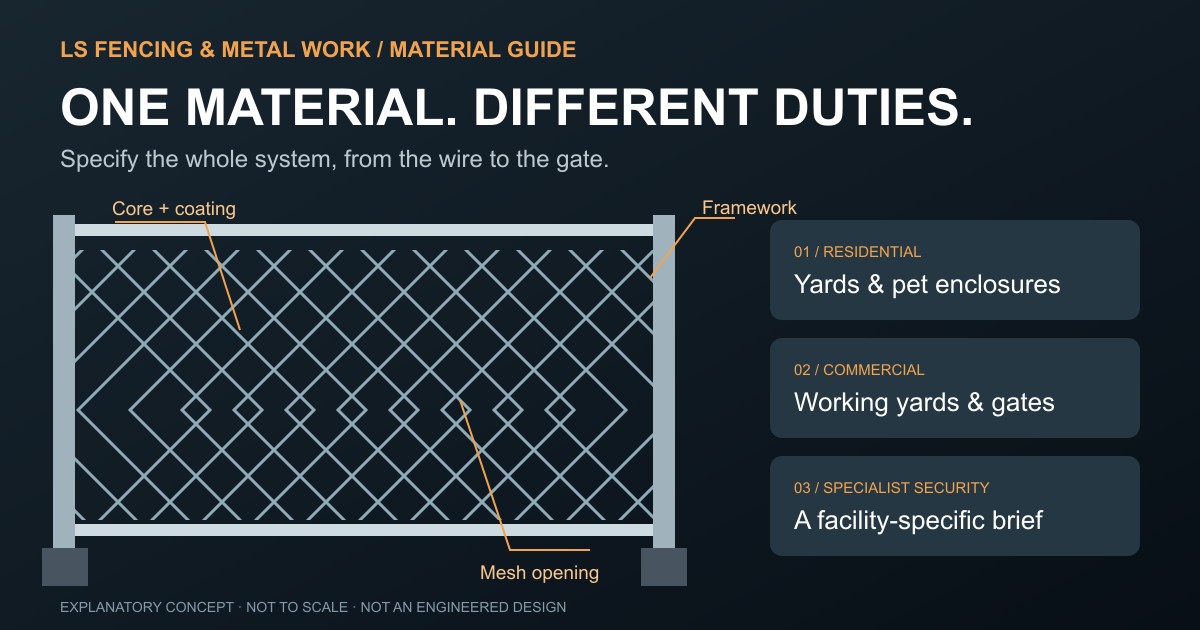
Original LS Fencing editorial illustration showing mesh, supporting framework and the progression from residential to specialist security applications. Concept comparison, not an engineered fence design.
Chain Link Fencing: From Backyard Boundaries to High-Security Perimeters
Luke Smith and LS Fencing & Metal Work: 15 years serving the Fraser Valley with industrial and residential fencing, barrier gates and practical chain-link advice.
A short garden boundary and the perimeter of a controlled facility can both use chain link, but they should not be bought from the same one-line description. The best-quality fence is the complete system that suits the property: fabric, posts, rails, fittings, foundations and gates, selected for the actual exposure and intended use.
For homeowners, that may mean a neat black fence with reliable pet access. For a contractor’s yard, it may mean a robust galvanized perimeter and a gate that handles daily deliveries. Correctional, secure healthcare and licensed cannabis facilities introduce different requirements again. This LS Fencing & Metal Work guide explains what to compare as the job grows from a small enclosure to a large perimeter.
Luke Smith and LS Fencing & Metal Work have spent 15 years serving the Fraser Valley, providing industrial and residential fencing and barrier gates. From a home boundary to a working yard entrance, the starting point is understanding what the fence and gate need to do.
Start small: residential yards and pet enclosures
For a residential fence, first describe what needs containing and how the yard is used. A small dog, an active large dog and a simple garden boundary call for different attention to mesh openings, bottom gaps and gates. Chain link preserves sightlines; it is not a solid privacy wall. Black or other dark finishes can be less visually prominent against planting than bright galvanized fabric.
Do not choose by height alone. Look at corners, changes of grade and the gate latch as closely as the straight runs. A fence that looks tidy across level ground may leave unsuitable gaps on a slope. Keep edges and hardware appropriate for the people and animals using the space. Pool barriers have additional requirements and need a separate assessment.
Wire gauge: ask what is inside the coating
For steel chain-link fabric, a lower gauge number generally means thicker wire. Common comparison points are 11 gauge, approximately 0.120 inches or 3.05 mm, and 9 gauge, approximately 0.148 inches or 3.76 mm. Nine-gauge wire has more steel than 11 gauge; that does not make every 9-gauge fence the right answer for every site.
The crucial question with polymer-coated fabric is the metallic-coated steel core diameter. The outer plastic makes the wire look thicker. Ask for the core gauge and coating specification in writing, rather than comparing finished outside diameters or colour alone. CLFMI’s commercial specification identifies the gauge of polymer-coated fabric by its metallic-coated steel core.
There are legitimate lighter residential specifications as well as heavier-duty options. Decide what the project needs, then compare matching specifications. Mesh size matters alongside gauge: a smaller opening changes the fabric’s behaviour and can make climbing more difficult, while also affecting wind loading and cost.
Galvanized, polymer-coated, aluminized or stainless?
Galvanized steel is a familiar starting point for chain link. Specify the protective coating, not just the word galvanized. A black polymer finish over a suitable metallic-coated core adds another protective layer and a different appearance. The polymer coating class, adhesion, damage resistance and treatment of the rest of the system should all be part of the discussion.
Aluminized fabric and zinc-aluminum alloy-coated fabric are separate coating options, not interchangeable names for stainless steel. Stainless steel may be worth investigating for demanding exposure, but alloy selection, availability, compatible fittings and total system cost need specialist supplier input. Neither material comes with a universal 30- or 40-year lifespan simply because of its name.
Salt exposure, persistent moisture, abrasion, coating damage and the maintenance programme all affect durability. Ask what protection is provided inside and outside posts and rails, how damaged finishes are repaired, and what the written warranty actually covers. A premium fabric paired with poorly protected fittings is an incomplete upgrade.
Posts and rails: compare dimensions and performance
Framework holds the fabric and transfers loads into the ground. Ask for outside diameter, wall thickness, steel grade or strength, protective coating, post spacing and footing design. Terminal and gate posts do different work from intermediate line posts. Their specification should reflect that role.
Names such as HF20, HF40 and Schedule 40 can appear in proposals, but they are not three interchangeable quality grades. HF product descriptions need to be tied to the supplier’s actual data; Schedule 40 identifies a pipe wall schedule for a nominal size and does not, on its own, describe the complete fence’s performance. Compare the specified dimensions, strength and applicable standards.
CLFMI specifications reference ASTM F1043 for industrial framework and ASTM F1083 for specified hot-dip galvanized pipe. Ask the supplier or designer to identify the applicable product standard and intended duty. A label such as heavy duty is less useful than a component schedule that can be checked.
Commercial yards: the entrance does much of the work
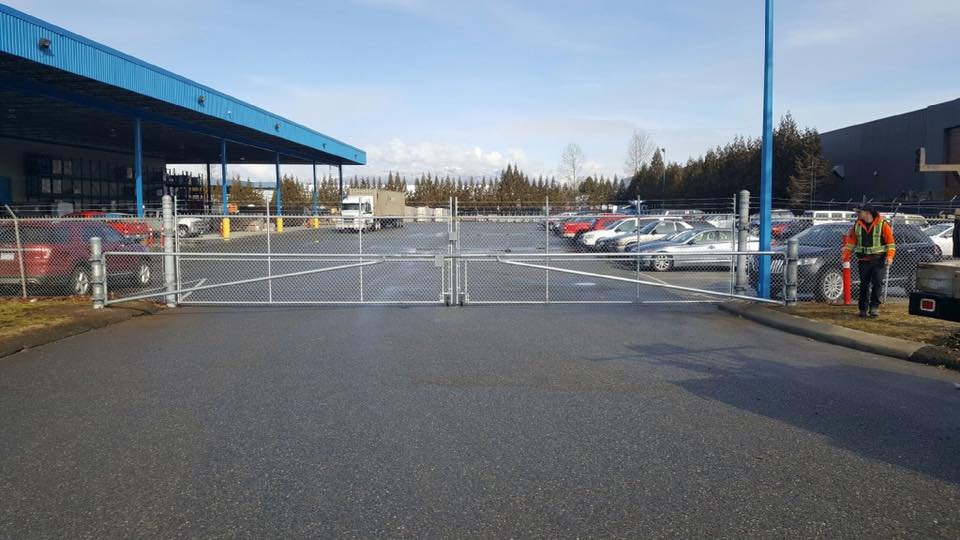
At warehouses, equipment yards, strata properties and service compounds, the gate often determines how well the fence functions day to day. Record the vehicles using the opening, delivery frequency, pedestrian routes, turning space and who is responsible for locking up. A gate that is inconvenient to use is more likely to be left open.
Swing gates need a clear arc. Sliding gates need side space; cantilever assemblies also need their support and runback area. Consider drainage, snow storage and surface movement before choosing a system. Automated access adds operator safety, power, protective devices and servicing requirements that need their own design and commissioning.
Privacy slats and wind: decide before construction
Privacy slats and screens change the loading on an otherwise open fence. Their effect belongs in the original specification, particularly at exposed properties, taller fences and installations with smaller mesh. Adding a screen later without checking the framework can change the job the posts and foundations must do.
Provide the proposed infill, height, location and exposure to the designer or installer. They can assess whether post sizes, spacing and foundations need changing. Manufacturer wind guidance is a design aid; the installation still needs to suit local conditions and the applicable project requirements.
Correctional facilities: a perimeter security system
For prisons and other correctional facilities, start with the authority’s security brief and procurement specification. Ordinary commercial chain link should not be described as correctional grade because it is tall or has a security topping. Required performance may involve specialist mesh, framework, attachments, foundations, access arrangements and tested assemblies.
The fence must be coordinated with observation, detection, lighting, access controls, inspection and response procedures. A product component’s test result is not automatically a certification of the finished perimeter. Design and acceptance belong with the facility’s responsible security and engineering team; this guide is not a claim that LS Fencing has completed any particular correctional project.
Secure healthcare: safety and dignity shape the brief
A secure mental-health facility is not simply a prison perimeter with a different sign. Its clinical and estates teams need to define the purpose of the outdoor space, patient safety, supervision, privacy, access and emergency arrangements. Surface details, possible climbing or ligature hazards, and the effect of an institutional-looking barrier need specialist consideration.
Chain link may be one option to assess, but it should not be presented as inherently safe for every patient environment. The clinical risk assessment may favour another perimeter system. Agree the design and approval process before pricing a generic height and gauge.
Licensed cannabis sites: match the licence and security plan
Licensed cultivation and processing facilities need a security plan suited to the activities and licence class. Health Canada describes physical barriers, restricted access, visual monitoring and other measures for relevant areas. Its guidance recognises firmly secured chain link as a possible barrier for outdoor grow areas; it does not make one generic fence package compliant for every licence.
Confirm the site boundary, controlled entrances, operations and storage areas, and coordination with the licence holder’s responsible security team. Do not assume that privacy slats or a particular gauge alone satisfy the requirements. Changes to a licensed site also need to be checked against the applicable approval process.
Compare a complete scope, from a dog run to a large perimeter
- Purpose, approximate length, desired height, finish and proposed fence line.
- Steel core gauge, mesh opening and specified coating system.
- Post and rail dimensions, strength, spacing, fittings and foundations.
- Pedestrian and vehicle gate openings, hardware, controls and operating needs.
- Slopes, drainage, wind exposure, existing surfaces and underground services.
- Removal, temporary security, restoration, inspection and maintenance responsibilities.
For a small job, photographs and rough measurements are a useful start. A larger or regulated project should have an agreed design brief and drawings before competing prices are treated as equivalent. Security-sensitive plans should be shared through the project’s approved private channel, not placed in a public enquiry or gallery.
Talk to LS Fencing & Metal Work about your Fraser Valley or Lower Mainland fence and gate project: call 604-758-0014 or email Lsfencingandmetalwork@gmail.com. Describe the property type, location, intended use and access needs so the team can discuss a suitable next step. For more chain-link information, follow the ChainLinkFencing.ca link below.
Frequently asked questions
- Is 9-gauge chain link better than 11-gauge?
- Nine-gauge steel wire is thicker, but the best specification also depends on mesh size, coating, framework, height, exposure and intended use. Compare the steel core gauge for coated fabric.
- Does black vinyl coating guarantee a longer fence life?
- It adds protection and changes appearance, but lifespan depends on the coating system, environment, damage, framework and maintenance. Ask for product specifications and written warranty terms.
- Can a standard chain-link fence suit a high-security facility?
- Only an assessment against the facility’s approved requirements can establish suitability. A generic residential or commercial specification is not proof of correctional, clinical or licence compliance.
Related services & guides
Sources & further reading
- ChainLinkFencing.ca — explore chain-link fencing
- CLFMI — residential quality and specification
- CLFMI — product, framework and wind-load references
- CLFMI — security planning guidance
- Health Canada — physical security measures by licence and area
Bylaws are updated by municipalities from time to time — always confirm current requirements before starting work.
Plan your fence or gate project
Tell LS Fencing your location, the type of work and your preferred timing.
Request a quoteBrowse all guidesEverything a strata council needs to know — barrier arms, parkade rolling doors, cantilever gates, chain link and security fencing, access control, Canadian regulations, and 2026 costs.
Heavy-gauge industrial perimeter security fencing for Langley BC — 6-gauge chain link, 358 anti-climb mesh, barbed and razor wire toppings, bylaw limits, footings and access control specs.
CSA Z614 playground fencing, basketball and tennis court perimeters, and dog park airlock gates in Langley, Surrey, Abbotsford and the Fraser Valley — specs, costs, permits and FAQs.