
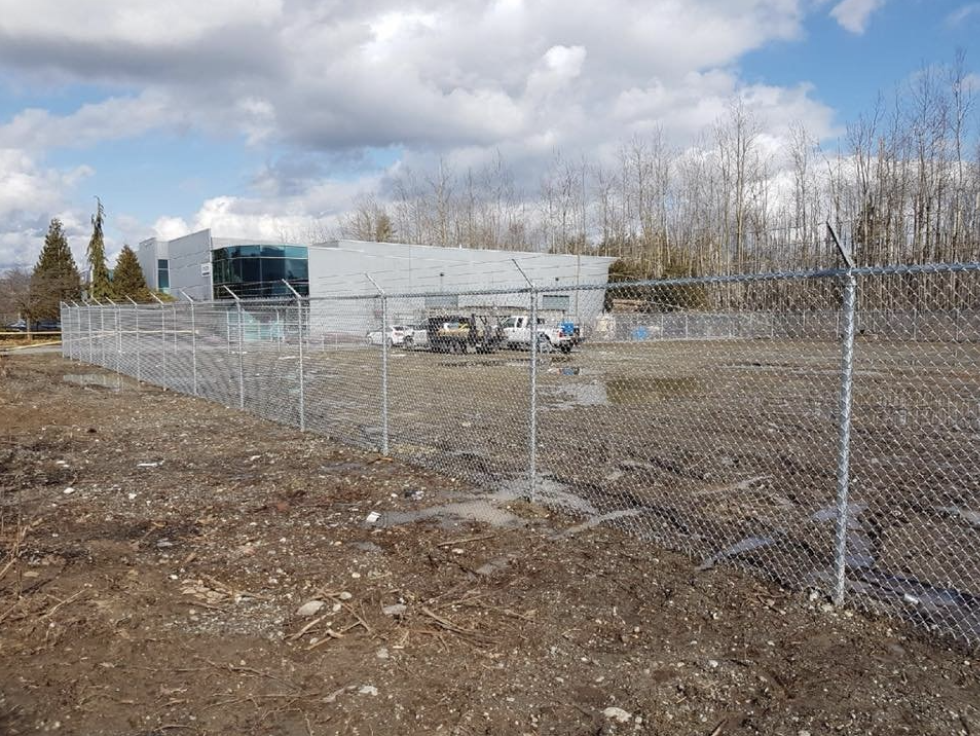
Heavy-gauge galvanized chain link industrial perimeter security fence with three-strand barbed wire topping in Langley, BC.
Industrial Perimeter Security Fencing in Langley, BC: Heavy-Gauge Systems & Security Wire
Heavy-gauge industrial perimeter security fencing for Langley BC — 6-gauge chain link, 358 anti-climb mesh, barbed and razor wire toppings, bylaw limits, footings and access control specs.
Protecting high-value industrial inventory, heavy machinery, logistics hubs, and critical infrastructure requires physical security boundaries engineered to delay, detect, and deter forced entry. In high-density industrial hubs across Langley, BC — including Campbell Heights, Gloucester Industrial Estates, Port Kells, and Aldergrove — perimeter fencing is the primary physical barrier against trespass, copper theft, vehicle breach, and organized property crime.
This guide covers technical specifications, structural engineering requirements, municipal bylaw compliance, and integration protocols for deploying heavy-gauge perimeter fencing with topped security wire across industrial properties in the Fraser Valley.
1. Executive summary: core architectural specifications
- Primary wire gauge: 6-gauge or 8-gauge heavy-duty chain link, or 8-gauge (4 mm) welded rigid mesh panels (358 anti-climb profile). Standard 9-gauge and 11-gauge wire are insufficient for high-value protection.
- Security topping: 3-strand 12.5-gauge high-tensile barbed wire on 45-degree extension arms, or helical concertina razor wire (CBT-65 / BTO-22) where zoning permits.
- System height: minimum 8 ft (2.4 m) fabric, plus 1–2 ft (0.3–0.6 m) of security wire topping — total security height 9.5 to 10 ft.
- Corrosion resistance: Class 2 hot-dip galvanized coating (min. 1.2 oz/ft² / 366 g/m²) or thermally fused PVC over galvanized steel core, engineered for Pacific Northwest precipitation.
- Post schedule: Schedule 40 structural pipe — minimum 2.875" O.D. terminal posts, 2.375" O.D. line posts — set in deep concrete footings below frost line.
2. Heavy-gauge fencing fabric options
Selecting the correct substrate depends on operational security level, visual impact, and resistance to manual breach tools such as bolt cutters, angle grinders, and vehicle impact.
- 6-gauge heavy industrial chain link — 0.192" core, 2"×2" diamond, high cut resistance. Open equipment yards, fleet parking, lumber mills.
- 8-gauge commercial chain link — 0.162" core, 2"×2" diamond, medium-high cut resistance. General warehousing and multi-tenant industrial parks.
- 358 high-security welded mesh — 8-gauge / 4 mm wire, 3"×0.5" (76.2 × 12.7 mm) micro-mesh. Extreme cut resistance, no finger or toe grip. Substations, data centres, high-value tech storage.
- Expanded heavy steel panels — 3/4" #9 expanded metal, raised diamond aperture, rigid continuous sheet. Scrap metal recycling and bonded customs yards.
6-gauge heavy-duty chain link
- Core material: cold-drawn steel wire, 75,000–95,000 PSI tensile strength.
- Selvage: knuckled top and bottom for low-risk zones; twisted/barbed selvage top and bottom for high-security applications to prevent unravelling.
- Key advantage: flexible structural response to wind load and terrain contours, with maximum resistance to impact from heavy machinery or yard transport.
358 anti-climb high-security mesh
- Aperture design: the 12.7 mm horizontal aperture blocks footholds and hand grip; 76.2 mm vertical spacing prevents standard bolt cutter jaws entering the grid.
- Structural integrity: rigid welded panels (2.5 m width) mounted to heavy RHS posts with anti-tamper security clamps and shear nuts.
3. Security wire systems: barbed and razor wire integration
Security wire toppings increase the height profile, eliminate climb-over capability, and present both a physical and psychological barrier.
3-strand barbed wire configurations
- Wire standard: ASTM A121 Class 3 galvanized or high-tensile 12.5-gauge wire with 4-point barbs at 3" or 5" intervals.
- 45-degree single arm: angled outward toward the threat side to push climbers off balance.
- V-arm (double arm): three strands inward and three outward — six total — creating a 24-inch overhead obstacle zone.
- Tensioning: mechanically tensioned with turnbuckles or inline strainers to prevent sag under snow load or manual pull-down.
Concertina and razor wire (tape)
- Tape profile: BTO-22 (22 mm barb) or CBT-65 (65 mm barb) stamped stainless strip clamped over a high-tensile galvanized spring-steel core.
- Coil diameter: 18" (450 mm) or 24" (600 mm) concertina loops fixed to the top rail or suspended between barbed wire extensions.
- Deployment: helical coil clipped at alternating points to form an expanding structure that resists crushing or manual compression.
"In high-risk commercial zones, security wire must keep the bottom strand at least 2.0 metres (6.5 ft) above grade to prevent accidental contact with pedestrians or staff."
4. Langley bylaws, zoning and environmental factors
Municipal regulatory framework
Under Township of Langley Master Zoning Bylaw 2500 and City of Langley Zoning Bylaw No. 3300, side and rear yard fencing in industrial zones (M-1A, M-2, M-3, M-5) is regulated to specific height limits. Fencing above roughly 2.0–2.4 m requires a building permit or structural variance.
- Front yard setbacks: industrial lots on arterials such as 200th Street, 56th Avenue and Fraser Highway face restricted front-yard fence heights (typically 1.2–1.8 m). High-security fence lines go behind the setback or pair with approved screening landscape.
- Industrial zones (M-1, M-2, M-3, M-6): barbed wire toppings are generally permitted provided the lowest strand is at least 2.0 m (6.5 ft) above finished grade.
- Razor wire and electrified systems: restricted in commercial and mixed-use light industrial areas. Heavy industrial use (M-3, bonded storage) requires municipal review, safety signage, and electrical certification to CSA SPE-1000.
- Corner lots: fences in the sight triangle (typically 6 m × 6 m to 9 m × 9 m) must stay open or under about 1.0 m so driver sightlines are preserved.
Climate and soil in Langley
- Langley sees over 1,400 mm of annual precipitation — raw steel and basic painted finishes rust-bleed within 24 to 36 months.
- All steel must be hot-dip galvanized post-fabrication to ASTM A123 / A121, or use a duplex system (galvanized core + zinc phosphate pre-treatment + architectural polyester powder coat).
- Port Kells, Northwest Langley and low-lying Aldergrove have high silt/clay content and fluctuating water tables.
- Footings must resist frost heave and lateral displacement: 36–42 inches (900–1050 mm) deep, with a diameter about three times the nominal post O.D.
5. Structural installation engineering and hardware
A security fence is only as strong as its posts and framework. The schedule below applies to heavy-duty industrial installations.
- Terminal, corner and pull posts: 2.875" (73 mm) O.D. up to 8 ft height; 4.000" (101.6 mm) O.D. above 8 ft or for heavy gate supports.
- Wall thickness: Schedule 40 pipe (0.203" / 5.16 mm wall).
- Line posts: 2.375" (60.3 mm) O.D. at maximum 8 ft (2.4 m) on-centre to withstand 100 km/h regional gusts with slat inserts installed.
- Top rail: 1.660" O.D. Schedule 40 pipe with swedged joints or sleeve couplings.
- Bottom edge: 7-gauge coil spring tension wire attached with heavy galvanized hog rings every 12 inches to stop bottom pull-up.
Gate engineering and automated access
- Cantilever slide gates: internal track frame engineered to 1.5× the opening width — a 30 ft clear opening needs 45 ft of total gate length — with no ground track to jam with snow, ice or gravel.
- Automated drives: continuous-duty 1–2 HP chain or hydraulic operators rated for high daily cycle counts.
- Safety and access: sensing loops, dual photoelectric beams, RFID keycards, cellular intercoms, and licence plate recognition cameras.
6. Access control and electronic security integration
Heavy perimeter fencing is the physical foundation for active detection — the barrier buys the response time that detection and monitoring convert into an intercept.
- Microphonic and fibre-optic intrusion cable mounted to 6-gauge chain link or 358 mesh detects cutting, climbing and panel lifting, triggering PTZ camera tracking.
- Infrared beam arrays and motion radar along the inner fence line create an active curtain zone with fewer false alarms from wind-driven debris or wildlife.
- CPTED: maintain a clear 3-foot zone on both sides of the fence line — no pallets, trees, or equipment that could serve as climbing aids.
- Perimeter LED lighting angled outward toward approach paths blinds intruders while preserving camera visibility.
7. Lifecycle cost and material evaluation
- Standard commercial 9-gauge chain link: lowest CapEx, standard labour, 12–15 year galvanized lifespan, cut with 18" bolt cutters. Fleet yards and basic storage.
- Heavy industrial 6-gauge chain link: medium CapEx, heavy equipment required, 25+ year lifespan, needs hydraulic cutters or a cutting wheel. Machinery yards, truck depots, logistics hubs.
- Ultra-security 358 welded mesh: highest CapEx and precision post layout, 30+ year lifespan, power tools required to breach, virtually zero maintenance. Substations, high-value tech, bonded yards.
Get a quote
LS Fencing & Metal Work builds industrial perimeter security fencing, barbed and razor wire toppings, and automated cantilever gates across Langley, Surrey, Abbotsford and the Fraser Valley. Call or text for a free site assessment and a written spec.
Frequently asked questions
- What is the maximum fence height allowed for industrial yards in Langley, BC?
- In industrial zones across the Township of Langley and the City of Langley, side and rear boundary fences are generally permitted up to 2.4 metres (8 feet) without a variance. With security wire topping the total height may reach 9.5 to 10 feet, subject to zoning overlays, setback lines, and structural permit review by the municipal building department.
- Is razor wire legal on commercial and industrial properties in the Fraser Valley?
- Razor wire (concertina tape) is subject to strict municipal bylaws. It is permitted on certain heavy industrial (M-3) or high-security utility sites but generally restricted or prohibited in light industrial (M-1/M-2) and commercial zones. Barbed wire is widely permitted on industrial sites when mounted on top extension arms with the lowest strand at least 2.0 metres (6.5 feet) above grade.
- What is the difference between 9-gauge and 6-gauge chain link wire?
- Wire core diameter and strength. 9-gauge measures about 0.148 inches (3.76 mm); 6-gauge measures 0.192 inches (4.88 mm). The 6-gauge wire carries over 60% more steel mass, giving significantly higher cut resistance and better impact tolerance against heavy yard equipment.
- How deep must fence post footings be poured in Langley, BC?
- To resist movement in wet silt and clay soils and seasonal frost expansion, posts should be set in concrete footings 36 to 42 inches deep (0.9 to 1.05 metres). Hole diameters run 10 to 12 inches for line posts and 12 to 16 inches for heavy terminal and gate posts.
- How does PVC coating protect high-security fencing near wet environments?
- PVC is thermally bonded over a hot-dip galvanized steel core wire. That duplex protection creates an impermeable barrier against rain, road salt spray, and atmospheric moisture, roughly doubling the service life of standard galvanized wire in coastal Pacific Northwest climates.
Related services & guides
Sources & further reading
- Township of Langley Zoning Bylaw 2500
- City of Langley (Zoning Bylaw No. 3300)
- WorkSafeBC — site safety and clearance
Bylaws are updated by municipalities from time to time — always confirm current requirements before starting work.
Plan your fence or gate project
Tell LS Fencing your location, the type of work and your preferred timing.
Request a quoteBrowse all guidesEverything a strata council needs to know — barrier arms, parkade rolling doors, cantilever gates, chain link and security fencing, access control, Canadian regulations, and 2026 costs.
CSA Z614 playground fencing, basketball and tennis court perimeters, and dog park airlock gates in Langley, Surrey, Abbotsford and the Fraser Valley — specs, costs, permits and FAQs.
Commercial and industrial chain link fencing in Abbotsford, BC — gauges, heights, gate types, permit rules, costs, and neighbourhoods we serve. Free on-site quotes from LS Fencing & Metal Work.