
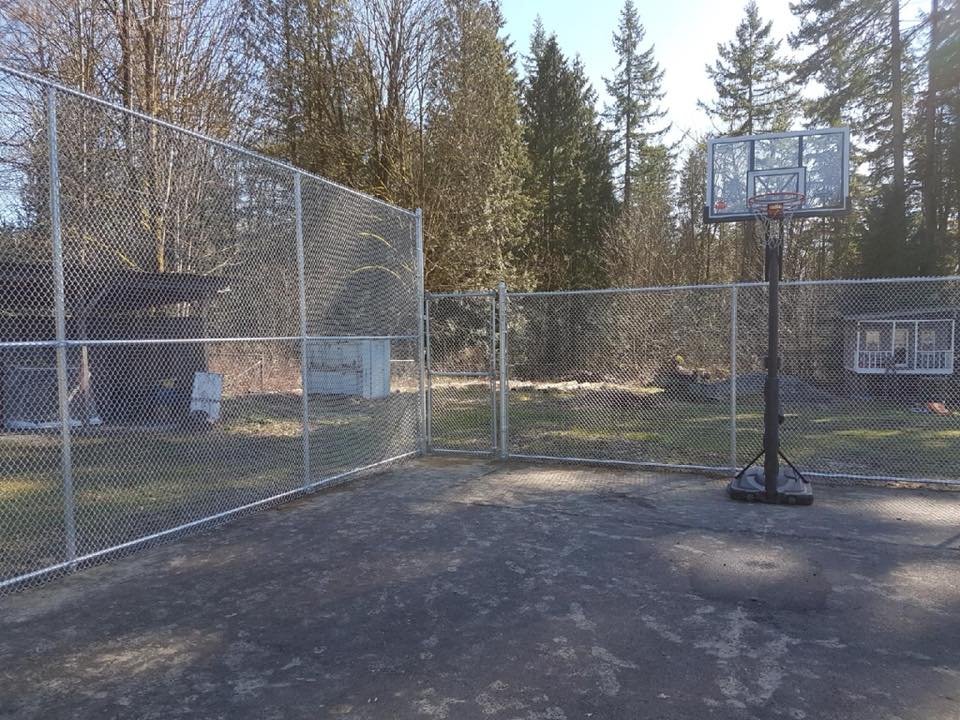
Galvanized commercial-grade chain link perimeter fence with walk-through gate around a private recreational court in the Fraser Valley.
Chain Link Fencing for Recreational Areas & Playgrounds in Langley
CSA Z614 playground fencing, basketball and tennis court perimeters, and dog park airlock gates in Langley, Surrey, Abbotsford and the Fraser Valley — specs, costs, permits and FAQs.
The installation above is a chain link perimeter fence around a private recreational court in the Fraser Valley. Galvanized commercial-grade chain link, walk-through gate with self-latching hardware, clean corner posts. Built to last 25 years with zero maintenance beyond an occasional inspection.
Recreational fencing is one of the most misspecified categories in residential and municipal projects. The wrong gauge, the wrong post spacing, the wrong gate hardware — and you have a fence that looks fine for two years and fails on year three.
Recreational and playground fencing — getting the spec right
Whether it's a backyard basketball court, a school playground, a municipal park, or a strata amenity area — recreational fencing has specific requirements that standard residential chain link doesn't meet.
CSA Z614 — the Canadian playground safety standard
CSA Z614 governs playground design and safety in Canada. For any playground adjacent to roads, water, or other hazards, compliant perimeter fencing is required. Key requirements:
- Maximum 89mm between pickets — prevents head entrapment for children under five
- No openings between 89mm and 230mm anywhere in the fence structure
- Minimum 1.2m height for standard perimeters — 1.5m adjacent to roads or water
- Top rail smooth with no climbing footholds
- All gates self-closing and self-latching, latch at minimum 1.5m height
- Gates open outward, away from the play area
- No sharp edges, points, or protrusions at child contact height
- Lead-free coatings and corrosion-resistant materials throughout
The most common specification mistake we see is residential-grade chain link installed on playground and recreational applications. Residential chain link uses lighter gauge wire — typically 11.5 gauge versus 9 gauge commercial — lighter posts, and lighter footings. It looks identical to commercial grade for the first year. By year three on a high-use recreational installation it's sagging, the gates are misaligned, and the posts are starting to lean. We've replaced a lot of it.
What commercial-grade recreational fencing actually means
- 9 gauge galvanized chain link fabric — not 11.5 gauge
- Schedule 40 steel line posts at 3.05m centres maximum
- Terminal posts — corners, ends, gates — at heavier wall thickness
- Concrete footings sized for post height and BC wind load
- Self-closing gate hinges rated for the duty cycle
- Self-latching hardware at appropriate height for the application
Recreational court fencing — basketball, tennis, multi-use
The photo above is a good example of a properly built recreational court perimeter. The chain link is installed tight to the ground with no gap for balls or small children to pass through. The walk-through gate has a self-closing spring hinge and a latch positioned above child reach. The corner posts are set in adequate concrete for the post height.
- Height: basketball courts typically use 3.0m to 3.6m fencing to contain balls; tennis goes higher — 3.6m to 4.8m on the ends. Multi-use courts depend on the primary sport.
- Gauge: 9 gauge minimum. High-impact areas — behind backboards, at tennis baselines — sometimes specify 6 gauge.
- Colour: galvanized is standard and most durable; black vinyl coated where aesthetics matter — strata, school yards, parks.
- Gates: one walk-through gate plus one equipment access gate wide enough for maintenance vehicles, both with self-closing hardware.
Municipal and strata recreational fencing
LS Fencing & Metal Work has installed recreational and playground perimeter fencing for strata corporations, schools, municipalities, and private landowners across Langley, Surrey, Abbotsford, Delta, and the Fraser Valley.
- Permit drawings and engineer-stamped post spacing calculations where required
- Full documentation for strata council approval
- WorkSafeBC compliance on all installation work
- Warranty documentation for strata records
- Coordination with landscape architects and project managers on larger builds
Dog park fencing vs playground fencing
These are frequently combined on the same municipal property — but they need different specifications. Playgrounds run 1.2–1.5m high with a child-safe high latch and quarterly inspections. Dog parks run 1.2–1.8m depending on breeds, need dig prevention at the bottom, monthly inspections, and a double-gate airlock entry — a small holding area between two gates so dogs can't bolt when owners enter or exit. We build airlock entries as standard on any dog park installation.
Get a quote
LS Fencing & Metal Work installs recreational, playground, and dog park fencing across Langley, Surrey, Abbotsford, and the Fraser Valley. Call for a free site assessment and we'll price the work in writing.
Frequently asked questions
- How much does recreational court fencing cost in BC?
- A standard basketball court perimeter in commercial-grade chain link typically runs $18,000 to $35,000 installed depending on court size, fence height, and gate configuration. Tennis courts run higher due to height requirements.
- Do I need a permit for recreational fencing in Langley?
- Fences over 1.8m in Langley Township and City of Langley require a permit. Recreational court fencing typically exceeds this height — we handle the permit application as part of the project.
- How long does a recreational fence installation take?
- A standard basketball or multi-use court perimeter takes 2–4 days with a full crew. Municipal projects with engineered drawings and permit requirements add lead time on the front end.
- What maintenance does chain link recreational fencing need?
- Minimal. Inspect quarterly for damage, sharp edges, and gate hardware function. Tighten any loose tension wire annually. Hot-dip galvanized chain link in BC's coastal climate typically lasts 25–40 years with no treatment.
- Can you match existing fencing on an expansion project?
- Yes — we carry standard commercial gauges and can match most existing installations. Send us a photo and we'll match the gauge, height, and finish.
Related services & guides
Plan your fence or gate project
Tell LS Fencing your location, the type of work and your preferred timing.
Request a quoteBrowse all guidesEverything a strata council needs to know — barrier arms, parkade rolling doors, cantilever gates, chain link and security fencing, access control, Canadian regulations, and 2026 costs.
Heavy-gauge industrial perimeter security fencing for Langley BC — 6-gauge chain link, 358 anti-climb mesh, barbed and razor wire toppings, bylaw limits, footings and access control specs.
Commercial and industrial chain link fencing in Abbotsford, BC — gauges, heights, gate types, permit rules, costs, and neighbourhoods we serve. Free on-site quotes from LS Fencing & Metal Work.