
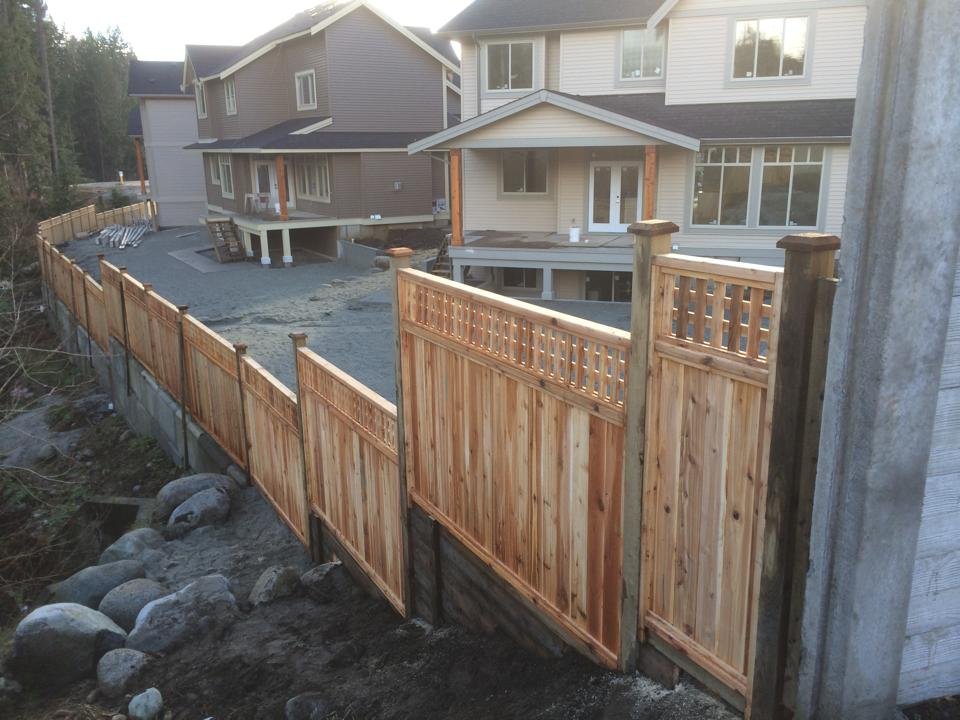
Six-foot western red cedar privacy fence with lattice-top panels stepped along a sloped new-construction property line in the Fraser Valley — Pitt Meadows, BC.
Fencing in Pitt Meadows, BC: Materials, Bylaws & Costs
Compare fence materials, local height rules, typical costs and installation considerations for properties in Pitt Meadows, BC.
Fencing in Pitt Meadows sits at the intersection of metro vancouver weather, tight municipal setback rules, and lots that range from pitt meadows is almost entirely flat river-plain agricultural land, with a compact residential core near the town centre and dyke-protected farmland covering most of the municipality. We've been installing chain link, cedar, ornamental steel, and custom gates across Pitt Meadows and the surrounding Fraser Valley for over a decade — this guide is a straight rundown of what actually works on the ground here, what the bylaw allows, and what a typical project looks like from quote to backfill.
Whether you're a homeowner in Downtown Pitt Meadows planning a backyard privacy fence, a property manager securing a strata perimeter, or a contractor lining up sub-trades on a Pitt Meadows commercial build, the same three things decide whether a fence lasts: post depth, post material, and how it's tied back to your specific soil and grade. That's what we'll cover.
Pitt Meadows is one of the most rural municipalities in Metro Vancouver, and that shapes almost every fencing job we do here. Working farms, equestrian properties, blueberry fields, and the Pitt Polder acreages all have containment needs that look nothing like a Vancouver rear yard. Our typical Pitt Meadows quote is 300 to 800 linear feet of 5-foot page-wire farm fence on treated posts, or standard 6-foot galvanized chain link for equipment-yard perimeters, with driveway gates sized to allow a tractor and trailer through. We factor a per-foot discount into any Pitt Meadows run over 500 feet because the setup and mobilization cost gets amortized across a bigger job.
Fencing conditions in Pitt Meadows
Pitt Meadows sits on the Fraser and Pitt river floodplain — 1,600 mm of rain a year, high water table, and significant summer humidity. For a fence that means UV, moisture cycling, wind loading, and — in the winter months — freeze-thaw at ground level. Every one of those wears on a different part of the assembly.
Pitt Meadows is almost entirely flat river-plain agricultural land, with a compact residential core near the town centre and dyke-protected farmland covering most of the municipality. That matters because the failure point of almost every fence is the post, and the post's job is to transfer wind load into the ground. Loose or shallow-sinking soil calls for deeper holes and a stiffer concrete mix; rocky or clay-heavy sites often need coring or a percussion bit rather than a standard auger.
- Post depth: minimum 30 in. for standard 6 ft residential fences, 36–42 in. for gates and any run over 6 ft.
- Concrete: crown the top so water sheds off the post rather than pooling around it.
- Fasteners: hot-dip galvanized or stainless — plain zinc-plated screws bleed rust within two winters on the coast.
- Rail spacing: three rails on any run over 5 ft, especially where wind rolls off open ground.
What we build most in Pitt Meadows
The projects we bid on across Pitt Meadows fall into a handful of recurring shapes: alr farm perimeter fencing, cedar privacy in bonson and osprey village, equestrian board fencing, dyke-adjacent chain link, and the odd custom gate or handrail welded up in our shop. Below is what each of those typically looks like for a Pitt Meadows property.
Residential privacy — cedar or black chain link
The most common request. A rear-yard cedar privacy fence at 1.83 m rear/side is the default look for most Pitt Meadows backyards. Black vinyl-coated chain link is a lower-cost alternative that disappears into landscaping and lasts twice as long. We frame in the gates the same day so nothing sits open overnight.
Commercial and strata perimeters
Galvanized chain link with a 9-gauge mesh, top and bottom rail, and either barbed wire or a smooth rail top depending on tenant use. Pitt Meadows strata boards typically want colour-matched black; commercial yards want visibility and drive-through gates sized for a semi.
Ornamental and driveway gates
Powder-coated ornamental steel for front yards on premium Pitt Meadows properties, plus custom cantilever or swing driveway gates fabricated and welded in-house. We tie into keypad, card-reader, or LTE gate operators as needed.
The residential half of Pitt Meadows — Bonson, Osprey Village, and the newer subdivisions in Central Meadows — is small enough that most homeowners already know their neighbours, which usually makes shared-fence conversations easier than in a big-city context. Standard spec is 6-foot cedar rear yards with black vinyl-coated chain link side yards, on treated posts set to 36 inches because the water table is high year-round. We use dry-mix bagged concrete tipped into the wet hole, which lets the groundwater hydrate it rather than fighting to keep the hole dry — a small trick that saves a lot of time on Pitt Meadows installs.
Permits and bylaws in Pitt Meadows
Pitt Meadows follows a standard height envelope for residential fences. Agricultural (ALR) properties allow taller and different fencing for livestock. Dyke setbacks are enforced.
Practically, in Pitt Meadows that means: 1.83 m rear/side, 1.2 m front. Corner lots almost always have an extra sightline triangle at the intersection where fence height drops to about 3 ft to protect visibility for drivers. Pools require their own enclosure standard under the BC Building Code regardless of what the city bylaw says.
We pull the current bylaw text from the City of Pitt Meadows — Building permits & inspections before every Pitt Meadows quote so the fence you approve is the fence we can legally build. If you're planning something above the standard height — a security perimeter, an equipment yard screen, an acoustic fence along a busy road — a variance is usually possible but adds four to eight weeks to the timeline.
- Front yard: typically capped lower than rear yard for streetscape and sightlines.
- Corner lots: sightline triangle rules apply at intersections.
- Pool enclosures: BC Building Code Part 9 governs — self-closing, self-latching gate required.
- Retaining-wall fences: anything over 1.2 m of exposed wall generally needs an engineered permit.
Materials that hold up in Pitt Meadows
Pitt Meadows' high water table and mostly agricultural land mean the majority of our work here is on treated posts set to 36 inches or deeper, with page-wire, high-tensile, or chain link mesh depending on use. We break the material choice down by where the fence lives — coastal exposure and shade both change what will actually last.
Galvanized and vinyl-coated chain link
The workhorse. Hot-dip galvanized before weaving is the spec you want — pre-galvanized wire rusts out at the cut ends within a decade in our climate. Black vinyl coating over galvanized adds another 15–20 years of corrosion protection and cuts glare, which is why it's the default on Pitt Meadows residential rear yards now.
Western red cedar
Locally milled, naturally rot- and insect-resistant, and the material of choice for privacy runs. Expect 15–25 years with basic maintenance — a stain or oil every 3–5 years extends that meaningfully. Rough-sawn boards weather to silver; smooth boards take stain more evenly.
Ornamental steel
Powder-coated steel picket for front yards, entry gates, and pool enclosures. Zero maintenance, holds up structurally for decades, and gives you the security of steel without looking like a jail yard.
Pressure-treated softwood — usually not
We rarely spec pressure-treated fence boards in Pitt Meadows. In our wet climate PT boards cup, twist, and check faster than cedar, and the cost gap has closed. Where we do use PT is for the posts inside concrete on cedar runs.
What fencing costs in Pitt Meadows
Pitt Meadows pricing is competitive on any acreage or long-run job because setup gets amortized over more linear feet. Small residential quotes price at the Fraser Valley standard. Ranges below reflect standard residential work in Pitt Meadows at current material and labour rates — final numbers depend on access, grade, gate count, and how many corners the run turns.
- Galvanized chain link (6 ft): ~$32–$48 per linear foot installed
- Black vinyl-coated chain link (6 ft): ~$42–$60 per linear foot installed
- Cedar privacy fence (6 ft, dog-eared or flat-top): ~$55–$85 per linear foot installed
- Cedar horizontal-slat privacy fence: ~$85–$120 per linear foot installed
- Ornamental steel picket (5–6 ft): ~$85–$140 per linear foot installed
- Custom swing or cantilever driveway gate: from ~$4,500 depending on span, material, and automation
Every quote is written on-site. No pressure sales, no phone-only estimates that fall apart the moment we see the actual grade.
Neighbourhoods in Pitt Meadows we work in most
We're on the road across Pitt Meadows weekly. Recent and recurring jobs cluster in Downtown Pitt Meadows, Bonson, Central Meadows, North Pitt Meadows, Osprey Village, Rural Pitt Meadows — a mix of postwar residential streets, newer strata developments, and light industrial pockets that all have their own quirks. If you're in Downtown Pitt Meadows or Bonson, chances are one of our trucks has been on your street this month.
Because we run our own excavation kit — a Kubota mini-excavator with a percussion post-drilling attachment — we handle the tighter, rockier, or root-bound lots that other crews subcontract out. That's a meaningful difference on older Pitt Meadows lots where roots and buried debris can stretch a straightforward install into a two-day dig.
How the job actually runs
Every fence we install follows the same rhythm — no surprises, no scope creep.
- Free on-site walk-through and written quote, typically within 48 hours
- Locate call to BC 1 Call before any digging (we handle it)
- Post holes dug and set with concrete, allowed 24–48 hours to cure
- Framing and mesh / boards / picket panels installed
- Gates hung, hardware set, site cleaned, final walk-through with you
A standard 100 ft residential run is usually a two-day job. Larger commercial perimeters, cantilever gates, or excavation-heavy sites get their own timeline in the written quote.
Why work with a local Pitt Meadows fence contractor
A national franchise install crew shows up with one panel spec, one post size, and a subcontractor holding the auger. That model works in a subdivision where every lot is identical; it does not work on a Pitt Meadows lot where the setback is tight, the neighbour's old post is buried in the wrong place, and the soil changes twice between the front and back property lines. Local matters because the person quoting your fence needs to have stood on the actual ground — read the grade, spotted the buried irrigation, confirmed the property pins — before the number goes on paper.
We're a family-run shop that has been welding gates and installing fence across Metro Vancouver since 2011. Same crew, same shop, same phone number. Every Pitt Meadows quote is written by someone who will be on the job site the day the auger runs. That's the meaningful difference: continuity from quote to installation to the warranty call two years later when a hinge needs an adjustment.
- Direct dispatch — the person quoting your Pitt Meadows job is the person running the crew.
- In-house welding shop — custom gates, brackets, and repairs fabricated on-site, not ordered in.
- Own excavation equipment — no waiting on a sub-trade to open post holes.
- Written, itemized quote — every line broken out so you can compare apples to apples.
- Warranty in writing — one year on labour, manufacturer coverage on materials.
Common Pitt Meadows fencing mistakes we get called to fix
A meaningful share of our Pitt Meadows calls are repairs — someone else built the fence three or five years ago, and the same handful of failures come up again and again. Sharing them here so you can spec around them the first time.
1. Posts set too shallow
We pull a lot of old Pitt Meadows posts out of 18-inch holes. 30 inches is the minimum for a 6-ft residential fence in our climate, and 36–42 inches for gates and taller runs. A shallow post looks fine until the first winter wind rocks it loose in the freeze-thaw.
2. Wrong fasteners
Plain zinc-plated deck screws are the single most common failure we see on Pitt Meadows cedar fences. They bleed rust within two winters and rot the board around the screw head. Hot-dip galvanized or stainless is the only defensible spec on the coast.
3. Ignoring drainage
A post hole that pools water becomes a rot column. Crown the concrete above grade so water sheds away from the post, and on wet Pitt Meadows lots consider a drainage rock base at the bottom of the hole.
4. Building over an unsurveyed line
On older Pitt Meadows blocks, the "obvious" fence line and the surveyed property line disagree more often than people expect. Building the new fence on the wrong line invites a bylaw complaint and, in the worst case, a tear-down order. When in doubt, get a survey.
Typical Pitt Meadows project timeline
For most Pitt Meadows homeowners the useful question is how many weeks from first call to finished fence. Below is a realistic timeline for a standard residential job in our current schedule — larger commercial perimeters or custom gate fabrication add lead time.
- Day 0 — you book a quote (phone, form, or email).
- Day 1–3 — we schedule an on-site walk-through and hand you a written quote.
- Day 4–14 — you approve; we schedule install and file the BC 1 Call locate.
- Install day 1 — post holes, posts set in concrete, cure overnight.
- Install day 2 — mesh / boards / picket panels installed, gates hung, site cleaned.
- Day of install — final walk-through, invoice, one-year workmanship warranty in writing.
In peak season (April through September) our schedule fills 3–5 weeks ahead. Booking a quote early — even before you're ready to commit — locks in the earliest install slot without any obligation.
"The best fence in Pitt Meadows is the one built for your specific lot — not a catalogue install dropped on top of your grade."
Ready to talk through a specific project? Book a free on-site quote and we'll walk your Pitt Meadows property together, pull the current bylaw, and price it in writing.
Frequently asked questions
- Do you install farm fencing in Pitt Meadows?
- Yes. Page-wire on treated posts, high-tensile electric, and standard chain link for livestock and equipment containment across ALR properties in Pitt Meadows. Longer runs earn a per-foot discount.
- Do I need a permit for a fence in Pitt Meadows?
- No permit for standard-height residential fences (1.83 m rear/side, 1.2 m front). Agricultural properties have different rules; dyke setback distances apply on any property backing onto the dyke system.
- Why do you set posts deeper in Pitt Meadows?
- The water table across most of Pitt Meadows is within a few feet of the surface year-round. Standard 30-inch post depth can walk out of soft, saturated ground over freeze-thaw cycles. We default to 36 inches on residential and 42 inches on gates.
- Can you install equestrian fencing in Pitt Meadows?
- Yes. Board fencing, page wire on treated posts, high-tensile electric, and cross-fencing for paddock rotation. We coordinate with the property owner on gate placement and cattle-guard entries as needed.
- How much does farm fencing cost in Pitt Meadows?
- $12–$22 per linear foot for 5-ft page-wire on treated posts, depending on terrain and gate count. Chain link on farm properties runs $28–$44 per linear foot. Longer runs (500+ ft) earn a per-foot discount.
Related services & guides
Sources & further reading
- City of Pitt Meadows — Building permits & inspections
- BC Building Code (Building & Safety Standards Branch)
- WorkSafeBC — worksite safety standards
Bylaws are updated by municipalities from time to time — always confirm current requirements before starting work.
Plan your fence or gate project
Tell LS Fencing your location, the type of work and your preferred timing.
Request a quoteBrowse all guidesCompare fence materials, local height rules, typical costs and installation considerations for properties in Surrey, BC.
Compare fence materials, local height rules, typical costs and installation considerations for properties in Langley, BC.
Compare fence materials, local height rules, typical costs and installation considerations for properties in Maple Ridge, BC.